

You notice the problem during the worst possible moment. Your AC starts blowing warm air on a 90-degree afternoon. Or it’s running constantly but your house feels like a sauna. Maybe you’re hearing grinding noises that weren’t there last week, or you’ve got water pooling around the unit.
Here’s what happens after we fix it. Your system cools your home evenly again, without the hot spots in certain rooms. Your energy bills drop because the unit isn’t working twice as hard to do half the job. You stop worrying about whether it’ll make it through another summer, because you know exactly what condition it’s in and what it needs.
That’s the difference between a quick patch job and residential AC repair in Hewlett, NY that actually solves the problem. You get your comfort back, your costs under control, and you know the system will hold up when the next heatwave hits Nassau County.
We’ve been repairing air conditioning systems across Nassau County since before most HVAC companies in the area existed. That’s over 30 years of service calls in Hewlett, from the Cape Cods and ranch homes near the Five Towns to the larger properties closer to Hewlett Harbor.
You’re not getting a corporate crew from out of state. You’re getting licensed, insured technicians who live in the area, know how coastal humidity affects AC performance, and understand what happens to systems after those temperature swings following summer storms off the Atlantic.
We show up when we say we will. We explain what’s wrong in plain language. We give you options, not a sales pitch. And we back our work with service warranties because we’re still going to be here next year when you need us again.

You call us at 516-248-2795 and describe what’s happening with your system. We schedule a time that works for you, often same-day if it’s an emergency. No runaround, no phone tree, just a real conversation about what you’re dealing with.
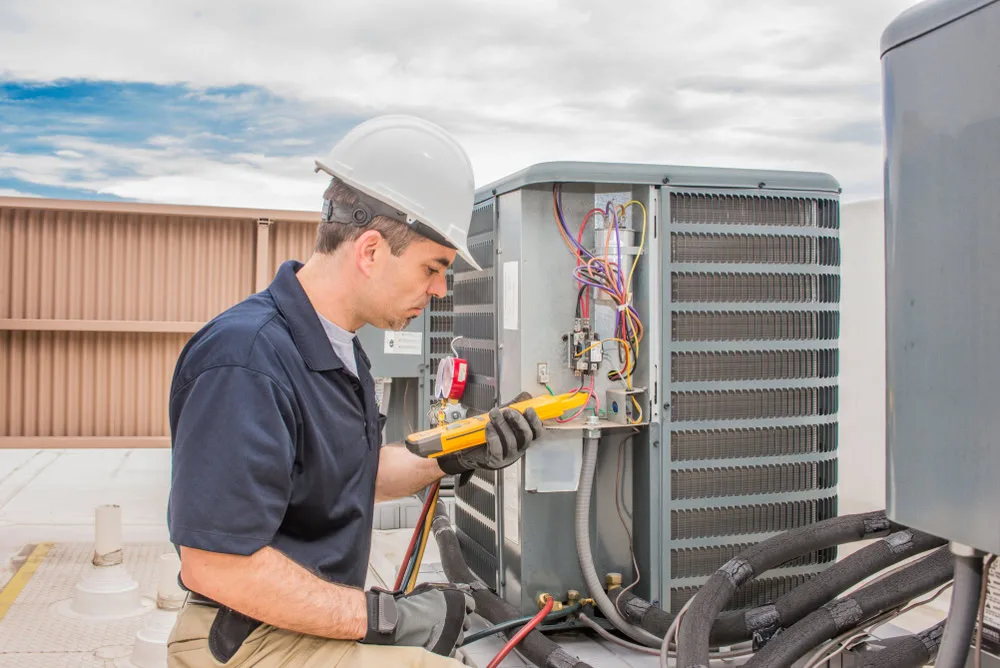
Our technician arrives with diagnostic equipment that pinpoints the issue fast. We’re talking thermal imaging, refrigerant gauges, electrical testing tools—not guesswork. Once we identify the problem, we walk you through what’s broken, why it happened, and what it’ll take to fix it. You get a clear price before any work starts.
Then we make the repair. That might mean replacing a failed capacitor, fixing a refrigerant leak, cleaning coils that are choking airflow, or swapping out a worn compressor. We test the system to make sure it’s cooling properly and running efficiently. You get documentation of what we did and recommendations for keeping it running smoothly. The whole process is straightforward because we’ve done this thousands of times across Hewlett and the surrounding Nassau County area.
Ready to get started?
Every air conditioner repair in Hewlett, NY starts with a full system diagnostic. We check refrigerant levels, test electrical components, inspect the condensate drain, examine the evaporator and condenser coils, and measure airflow. You need to know what’s actually wrong, not just what seems broken.
From there, we handle whatever your system needs. Refrigerant leaks get located and sealed before we recharge the system to manufacturer specs. Failed capacitors, contactors, or relays get replaced with quality parts. Frozen coils get thawed and we fix whatever caused the freeze in the first place—usually airflow restriction or low refrigerant. Compressor issues get addressed based on whether repair or replacement makes more sense for your situation and budget.
Hewlett’s coastal location means your outdoor unit faces salt air, humidity spikes, and debris from storms. We clean and inspect components that take the most abuse in this climate. And because homes here range from smaller ranches to larger properties with multiple zones, we work on all system types: central air, ductless mini-splits, heat pumps, and multi-zone setups from every major manufacturer.
If your system is under 10 years old and the repair costs less than half of a new unit, fixing it usually makes sense. You’re looking at maybe a failed part or a maintenance issue that’s been neglected, and those are straightforward fixes that buy you several more years of reliable cooling.
Once a system hits 12-15 years old, you need to factor in efficiency and reliability. Older units use more electricity to produce the same cooling, especially if they’re running on R-22 refrigerant that’s been phased out and costs a fortune to recharge. If you’re facing a major repair like a compressor replacement on an aging system, you might spend $1,500-$2,500 on a fix that only extends the life another few years—while a new, efficient system would pay for itself through lower energy bills.
We’ll tell you honestly which route makes more sense for your situation. Sometimes a repair gets you through another season while you budget for replacement. Other times, you’re throwing good money after bad and a new system is the smarter play. We’re not here to sell you something you don’t need, but we’re also not going to let you waste money on a repair that doesn’t make financial sense.
Warm air from your vents usually means one of three things: low refrigerant, a frozen evaporator coil, or a failed compressor. Low refrigerant happens when there’s a leak somewhere in the system—refrigerant doesn’t just disappear, so if levels are down, something’s leaking and needs to be sealed before we recharge it.
A frozen evaporator coil seems backwards, but it stops the cooling process completely. This happens when airflow gets restricted by a dirty filter, blocked return vents, or a failing blower motor. It can also happen when refrigerant levels drop too low. The ice has to thaw before we can fix the underlying cause, which is why your system might blow warm air for a while even after we start working on it.
Compressor failure is the most serious cause. The compressor is the heart of your AC system—it circulates refrigerant and makes the cooling happen. When it fails, the outdoor unit might still run but no actual cooling occurs. You’ll hear the fan spinning outside, but the air coming through your vents stays warm. This is a major repair, and on older systems it often makes more sense to replace the whole unit than sink money into a new compressor.
Water leaking from your indoor unit almost always traces back to the condensate drain line. Your AC pulls humidity out of the air as it cools, and that moisture has to go somewhere—normally through a drain line that carries it outside or to a floor drain. When that line gets clogged with algae, mold, or debris, water backs up and overflows from the drain pan.
In Hewlett’s humid climate, condensate lines work overtime during summer. That constant moisture creates perfect conditions for biological growth inside the line. A clog can form gradually, and you won’t notice until water starts dripping from the unit or pooling on the floor underneath it. We clear the blockage, clean the line, and treat it to prevent future growth.
Sometimes the drain pan itself is the problem. Older pans rust through or crack, especially if they’ve been holding standing water from a slow drain. And occasionally, the issue isn’t the drain system at all—it’s a frozen evaporator coil that’s thawing and producing more water than the drain can handle. We diagnose which situation you’re dealing with and fix it properly so you’re not mopping up water every time the AC runs.
Once a year, before cooling season starts, is the standard recommendation. That means scheduling service in late spring before you’re running the AC daily through summer. Annual maintenance catches small problems before they turn into expensive failures during the hottest weeks of the year.
During a maintenance visit, we’re checking refrigerant levels, cleaning coils, testing electrical components, inspecting the condensate drain, measuring airflow, and making sure the system runs efficiently. These aren’t things you can see or check yourself, but they directly affect whether your AC makes it through summer without breaking down. A system that’s maintained regularly uses less energy, cools more effectively, and lasts years longer than one that only gets attention when something breaks.
Hewlett’s location near the coast means your outdoor unit deals with salt air, high humidity, and debris from storms. That environment is harder on AC equipment than drier inland areas. The outdoor coils collect more grime, electrical connections corrode faster, and drain lines clog more frequently. Annual service accounts for these local conditions and keeps your system running reliably despite the extra stress from coastal weather.
Strange noises are the biggest red flag. Grinding, squealing, or banging sounds mean something’s failing mechanically—usually a motor bearing, a loose component, or a failing compressor. These problems get worse fast, and running the system after you hear these noises can turn a manageable repair into a complete system replacement.
Weak airflow from your vents signals a problem with the blower motor, a clogged filter, or ductwork issues. If some rooms aren’t cooling while others are fine, you might have a zoning problem or blocked vents. But if airflow is weak throughout the house, the blower assembly needs attention before the motor burns out completely.
Short cycling—when the system turns on and off every few minutes instead of running normal 15-20 minute cycles—means the unit is struggling. This could be a refrigerant issue, a failing compressor, a bad thermostat, or an oversized system for your space. Short cycling wastes energy, fails to remove humidity properly, and puts enormous stress on components. Your electric bill spikes, your home stays uncomfortable, and you’re headed toward a breakdown if it doesn’t get fixed.
Yes. We work on central air systems, ductless mini-splits, heat pumps, and multi-zone setups from every major manufacturer. That includes Carrier, Trane, Lennox, Goodman, Rheem, York, Mitsubishi, Daikin, and every other brand you’ll find in Hewlett homes. Thirty years in business means we’ve seen and fixed just about every system and problem that exists.
Different brands have different quirks, but the fundamentals are the same. Refrigerant systems operate on the same principles whether it’s a budget-friendly builder-grade unit or a high-end variable-speed system. We carry common parts on the truck, and for less common components, we have supplier relationships that get us what we need quickly. You’re not waiting a week for a part that’s sitting in a warehouse 20 minutes away.
The bigger difference is system type, not brand. Ductless systems require different diagnostic approaches than central air. Heat pumps have components that standard AC units don’t. Multi-zone systems need balancing and control expertise. We handle all of it because homes in Hewlett have all of it—from original central air systems in midcentury ranches to newer ductless installations in renovated properties. Whatever you’ve got, we’ve fixed it before.