

You’re not looking for a lecture about HVAC systems. You need your home comfortable again, and you need to know it won’t break down next week.
When we handle your air conditioner repair in Williston Park, NY, you get a system that cools consistently, runs efficiently, and doesn’t spike your electric bill every month. We use digital diagnostics to find exactly what’s wrong—no guessing, no upselling parts you don’t need.
Most repairs get done the same day. You’ll know the cost before we start, and you’ll get a printed efficiency report showing how your system is actually performing. That’s not standard in this industry, but it should be.
If your AC is struggling to keep up with Nassau County’s summer humidity, making strange noises, or cycling on and off constantly, those are signs of specific problems we can fix. Ignoring them costs more later—in emergency service calls, in wasted energy, and in replacing a system that could’ve been saved.
We’ve been keeping Long Island homes comfortable for years. We’re based here, we know Nassau County’s climate, and we understand what your cooling system deals with during July and August.
Your home is likely worth close to $850,000 in Williston Park. Protecting that investment means maintaining the systems that keep it livable. We’re not the cheapest option, and that’s intentional—you’re paying for technicians who show up on time, communicate clearly, and fix the actual problem instead of masking it.
We service all makes and models. We don’t push you toward unnecessary replacements. And if you call with an emergency, we treat it like one.

First, we listen. You tell us what’s happening—no cooling, weird sounds, water leaking, whatever it is. We schedule a time that works for you, and we show up when we say we will.
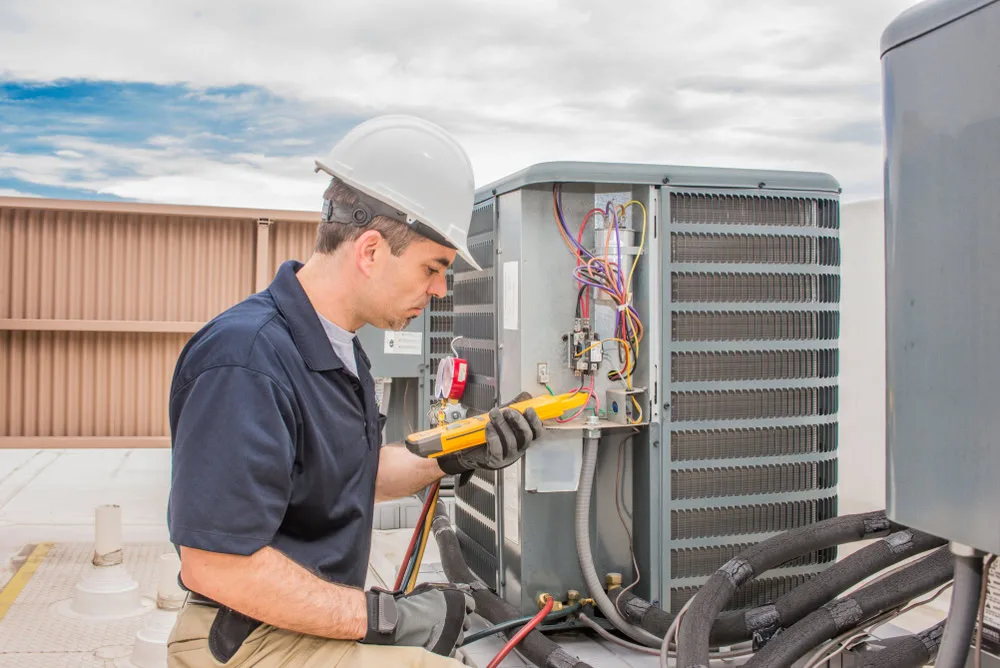
Once we’re there, we run a full diagnostic using digital tools that measure your system’s actual performance. This isn’t a visual inspection and a guess. We’re checking airflow, refrigerant levels, electrical components, and efficiency ratings. You get a printout of the results.
Then we explain what we found in plain terms. If it’s a simple fix, we handle it right away. If it’s more involved, we walk you through your options with upfront pricing—no hidden fees, no pressure. Most residential AC repair in Williston Park, NY gets completed the same visit.
After the repair, we test everything to make sure it’s running the way it should. You’ll feel the difference immediately, and your system will run more efficiently going forward. We also let you know if there’s anything else worth keeping an eye on, so you’re not blindsided later.
Ready to get started?
Every home AC repair in Williston Park, NY includes a complete system evaluation. We’re not just fixing the immediate issue—we’re making sure nothing else is about to fail.
That means checking your condensate drain, which tends to clog in humid climates like ours. It means inspecting your evaporator coils, testing your thermostat calibration, and making sure your refrigerant levels are where they need to be. Low refrigerant doesn’t just mean weak cooling—it can freeze your system and cause compressor damage.
If your AC is leaking water, that’s usually a drain line problem or a frozen coil. Both are fixable, but they need attention fast before you’re dealing with water damage inside your home. We handle AC leaking water repair on the spot in most cases.
You’ll also get honest advice about whether a repair makes sense or if you’re better off replacing the unit. We’re not going to sell you a new system if yours has years left. But if you’re dumping money into an old unit that’s going to fail anyway, we’ll tell you that too. Most central AC systems last 15 to 20 years with proper maintenance—if yours is near the end and needs a major repair, replacement might be the smarter move financially.
If your system is under 10 years old and the repair costs less than half the price of a new unit, repair almost always makes sense. You’re extending the life of equipment that still has years left, and you’re avoiding the expense and disruption of a full replacement.
Once your system hits 15 years or older, the math changes. Older units are less efficient, parts get harder to find, and one repair often leads to another within a year or two. If the repair estimate is more than $1,000 and your system is already past its expected lifespan, replacement is usually the better investment.
We’ll give you both options with real numbers. If your 18-year-old AC needs a new compressor, we’re not going to pretend that’s a great use of your money. But if your 7-year-old system just needs a capacitor replaced, there’s no reason to buy new equipment.
Weak airflow is the first thing most people notice. If you’re standing in front of a vent and barely feeling anything, that’s usually a blower motor issue, a clogged filter, or ductwork problems. It’s not something that fixes itself.
Strange noises are another big one. Hissing means refrigerant is leaking. Grinding or squealing points to motor bearings wearing out. Banging or clanking means something’s loose inside the unit. Each sound tells us exactly where to look.
If your system is running constantly but your home isn’t cooling down, that’s a sign of low refrigerant, a failing compressor, or an undersized system for your space. And if you’re seeing water pooling around your indoor unit, your drain line is clogged or your evaporator coil is frozen—both need immediate attention before you have water damage.
Most repairs fall between $250 and $600, depending on what’s wrong. A capacitor replacement or a thermostat fix is on the lower end. A refrigerant recharge or a blower motor replacement costs more.
If you need a compressor or a full coil replacement, you’re looking at $1,200 to $2,000. At that point, we’re having a conversation about whether the repair makes sense given the age and condition of your system.
We give you the price before we do the work. You’ll know exactly what the repair costs, what it includes, and how long it should take. There’s no “we’ll figure it out as we go” pricing. And if we find something else while we’re in there, we’ll let you know what it is and what it costs to fix—but we’re not adding charges without talking to you first.
Annual maintenance catches most problems before they become emergencies. A tune-up in the spring means we’re cleaning coils, checking refrigerant, testing electrical connections, and making sure everything’s ready for the workload of summer.
Changing your filter every 1 to 3 months is the simplest thing you can do. A clogged filter makes your system work harder, reduces airflow, and leads to frozen coils. It’s a $20 fix that prevents a $500 repair.
You should also keep the area around your outdoor unit clear. If it’s surrounded by plants, debris, or lawn clippings, it can’t breathe properly. That reduces efficiency and puts extra strain on the compressor.
If you notice anything off—weak cooling, strange sounds, higher electric bills—don’t wait until it’s 90 degrees and your system quits completely. Catching issues early almost always costs less than waiting for a full breakdown.
Yes. If your AC goes out and your home is getting unbearable, we treat that as an emergency. We’ll get someone to you as quickly as possible—same day in most cases.
Emergency calls do come with a premium, but that’s because we’re prioritizing your job and pulling a technician from other scheduled work. You’re paying for speed and availability, not for the repair itself to cost more.
If it’s late at night or a weekend and your system isn’t completely dead—maybe it’s cooling poorly but still running—you can often wait until regular hours and save the emergency fee. But if you’ve got young kids, elderly family members, or health concerns, don’t tough it out. Call us and we’ll take care of it.
Low refrigerant is the most common cause. If there’s a leak somewhere in the system, your AC can’t absorb heat properly, so it just blows air without actually cooling it. We find the leak, fix it, and recharge the system.
A failing compressor is another possibility. The compressor is what circulates refrigerant through the system—if it’s not working right, nothing else matters. You’ll hear the unit running outside, but there’s no real cooling happening inside.
Frozen evaporator coils also cause this. If airflow is restricted because of a dirty filter or a blower problem, the coil gets too cold, freezes over, and stops absorbing heat. Once we thaw it out and fix the airflow issue, cooling comes back.
Sometimes it’s as simple as a miscalibrated thermostat telling the system to shut off before your home actually reaches the temperature you set. We test all of this during the diagnostic so we’re fixing the real problem, not just guessing.