Summary:
Most Queens County homeowners do one thing for their AC before summer: they change the filter. Maybe. And then they cross their fingers.
That’s not a knock — it’s just the reality. Nobody hands you a maintenance checklist when you buy a house in Bayside or sign a lease in Forest Hills. You figure it out as you go, usually after something breaks.
Here’s what we’ve seen after nearly two decades of servicing AC systems across Queens County: the failures that happen in July almost always trace back to something that was skippable in May. This post walks through the 11 maintenance tasks that most homeowners overlook — what they are, why they matter, and which ones you can handle yourself versus when it’s time to call us.
Essential Air Conditioner Maintenance Tasks for Queens County Homes
Queens County is not a forgiving environment for AC systems. You’ve got humidity rolling in off Jamaica Bay, salt air working on outdoor units in southern and eastern neighborhoods, and an urban heat island effect that pushes ambient temperatures several degrees higher than surrounding areas. Your system runs harder and longer here than it would almost anywhere else in the region.
That context matters because it changes what “good enough” maintenance actually looks like. A task that’s optional in a drier climate becomes necessary here. A once-a-year check becomes a twice-a-year check. And the tasks most homeowners skip entirely? Those are the ones that cause the mid-summer breakdowns.
DIY AC Maintenance: What You Can Safely Do Yourself
Let’s start with the honest version of this conversation. There are things you can and should do on your own, and there are things that require a licensed technician — not because we want the work, but because getting it wrong creates real problems.
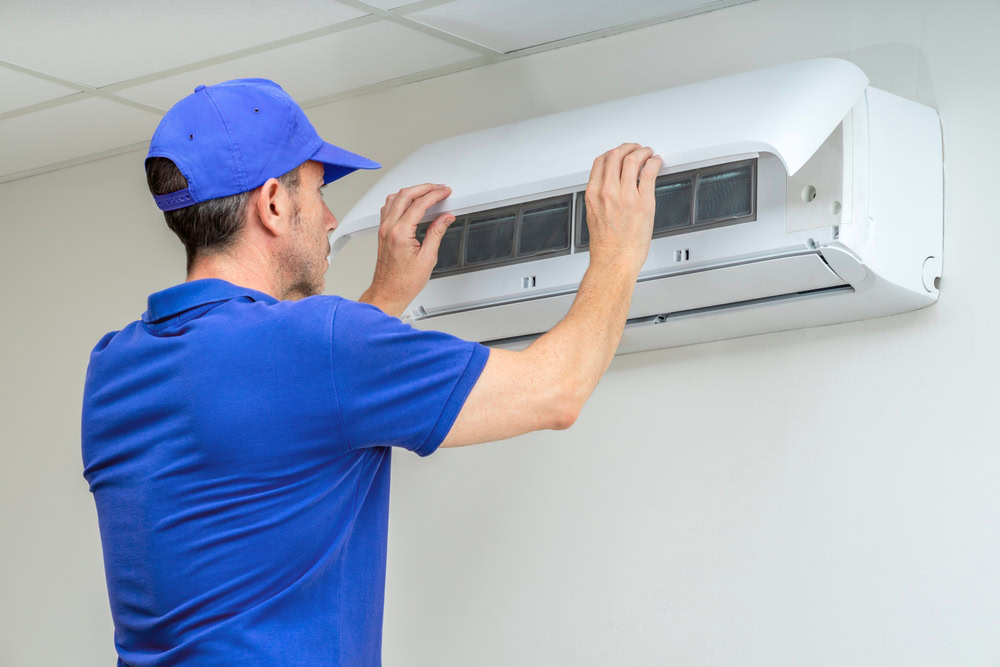
Changing your air filter is the obvious one. Do it every 30 to 90 days, and lean toward the shorter end if you have pets, live near a heavily trafficked road, or notice your home collecting dust faster than usual. Queens County’s spring pollen season is no joke, and a clogged filter doesn’t just reduce airflow — it forces your system to work harder, which shows up directly on your Con Edison bill. Research from the Department of Energy puts the energy penalty for a dirty filter at 5 to 15 percent over a full summer.
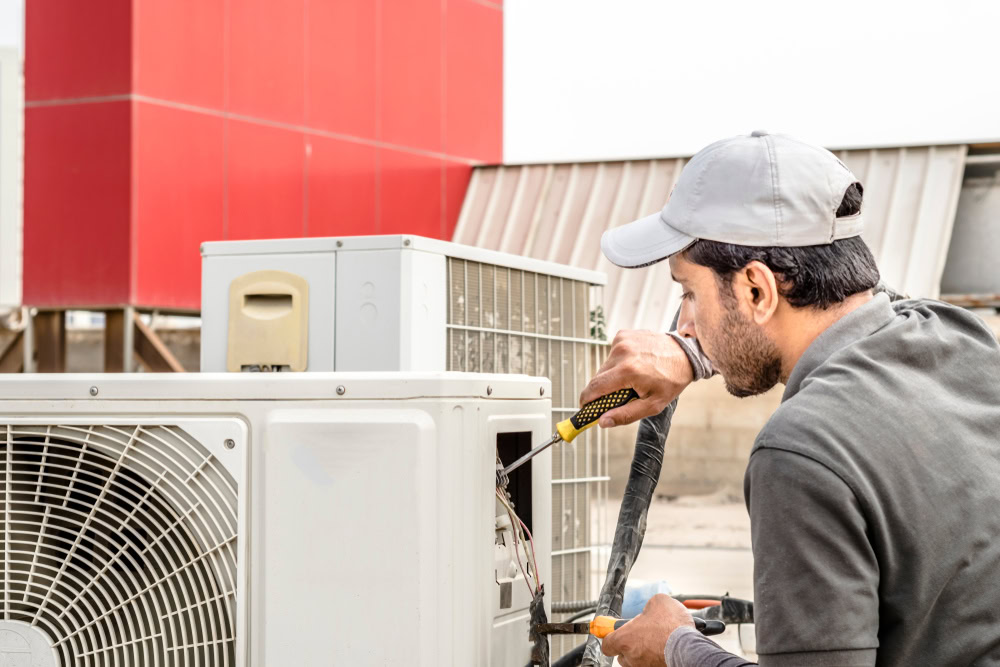
Beyond the filter, you can clear the area around your outdoor condenser unit. Give it at least two feet of clearance on all sides — no overgrown shrubs, no debris, no lawn furniture pushed up against it. Rinse the exterior fins gently with a garden hose if they’ve collected dirt or cottonwood. Don’t use a pressure washer; the fins are delicate and bend easily.
Check your thermostat. Make sure it’s reading accurately and responding correctly. If it’s an older model, it may be worth replacing it with a programmable or smart thermostat before the season starts — not because it’s a maintenance requirement, but because it’s one of the easiest efficiency upgrades you can make.
Inspect your supply vents and return air grilles. Make sure none of them are blocked by furniture, rugs, or curtains. Restricted airflow is one of the most common causes of uneven cooling, and it’s one of the easiest things to fix.
Finally, look at your condensate drain line — the small PVC pipe that runs from your indoor air handler to a drain. This is the one most homeowners have never thought about. When your AC runs, it pulls humidity out of the air, and that moisture has to go somewhere. The condensate drain handles it. In Queens County’s humid summers, that line can clog with algae or debris, causing water to back up into the system or overflow into your ceiling or walls. Pouring a cup of distilled white vinegar down the drain line every few months keeps it clear. It takes two minutes and can prevent hundreds of dollars in water damage.
Professional AC Maintenance: What Needs a Licensed Technician
Some tasks on the maintenance list aren’t about skill — they’re about safety, legal compliance, and equipment you simply don’t have at home. This is where a professional tune-up earns its cost.
Refrigerant level checks are the most important one. If your system is low on refrigerant, it won’t cool effectively, and it will run longer and harder trying to compensate. Checking and adjusting refrigerant requires EPA Section 608 certification — it’s a federal requirement, not a formality. Anyone who offers to check your refrigerant without that certification is working outside the law, and any work they do could void your manufacturer’s warranty.
This is especially relevant right now. R-410A, the refrigerant used in most residential AC systems installed before 2025, is being phased out. New units are moving to R-454B and R-32. If your system uses R-410A and develops a leak, you need a licensed technician to address it before supplies become harder to source. It’s a conversation worth having before summer, not during it.
Electrical component inspection is another professional task. Capacitors and contactors — the components that start your compressor and keep it running — degrade over time and can fail without warning. Testing them requires the right equipment and an understanding of what normal readings look like. A failing capacitor often shows no obvious symptoms until the system won’t start on a 95-degree afternoon.
Evaporator coil cleaning is also on the professional side. The evaporator coil sits inside your air handler and is responsible for absorbing heat from your home’s air. Over time, it accumulates dust, mold, and debris — especially in humid environments like Queens County, where condensation is constant. A dirty coil reduces efficiency significantly, and cleaning it properly requires coil cleaner and careful handling to avoid damaging the fins.
A complete professional tune-up should also include a blower motor inspection, a check of all electrical connections and wiring, a review of the ductwork for obvious leaks, and a combustion or carbon monoxide test if you have a gas furnace in the same system. If a company is offering a tune-up for $49 and it takes 20 minutes, it’s not a tune-up — it’s a foot in the door.
What Queens County Homeowners Actually Pay for AC Maintenance
Cost is usually the reason people put off scheduling a tune-up. So let’s put actual numbers on it.
A professional AC tune-up in Queens County typically runs between $150 and $250 for a single visit. That’s higher than the national average, which reflects New York’s cost of living and the higher overhead of operating in the metro area. It’s not a surprise if you’ve hired any kind of contractor in Queens County recently.
What you get for that should be clearly itemized before anyone touches your system. No hidden fees, no “we found something” surprises without a conversation first. If a company can’t tell you what’s included before they start, that’s a red flag worth taking seriously.
AC Tune Up Cost: One-Time Visit vs. Annual Maintenance Plan
The one-time tune-up is what most people think of first, but it’s worth understanding how it compares to an annual maintenance agreement before you decide.
A one-time visit in Queens County will typically cost $150 to $250 and covers your system for that visit. You schedule it, a technician comes out, inspects and services the unit, and you’re done until next year — at which point you’ll pay again at whatever the current rate is.
An annual maintenance plan usually runs $120 to $360 per year and tends to include two visits — one in spring for the AC system, one in fall for the heating side. Most plans also include priority scheduling, which matters more than people realize. During a heat wave in Queens County, HVAC companies book out five to seven days. If you’re on a maintenance plan, you’re typically moved to the front of the line. That alone can be worth the cost of the plan.
Some plans also include discounts on parts and labor if a repair is needed during the contract period. If your system is more than eight or ten years old, that discount can offset the plan cost entirely on a single repair.
The math is straightforward. A tune-up costs $150 to $250 per year. An emergency repair, if something fails because a capacitor wasn’t checked or a refrigerant issue wasn’t caught, typically runs $300 to $1,500 or more. A full system replacement runs $5,000 to $10,000. Regular maintenance is the cheapest option by a significant margin — and it’s the only one that keeps you comfortable through the summer rather than scrambling for a technician.
Research consistently shows that AC systems receiving regular maintenance last 40 percent longer than those that don’t. The difference between a system that fails at 10 years and one that runs cleanly to 18 or 20 years is largely a maintenance story. At $5,000 to $10,000 for replacement, those extra years have real value.
Central AC Maintenance in Queens County: What the Humidity Does to Your System
Central AC systems in Queens County face a specific set of challenges that don’t show up in national maintenance guides, and it’s worth understanding them before summer.
The humidity is the biggest factor. When the relative humidity outside is consistently above 70 or 80 percent — which is normal for Queens County in July and August — your AC isn’t just cooling the air, it’s working overtime to dehumidify it. That puts sustained stress on the compressor, accelerates wear on the evaporator coil, and fills your condensate drain with more moisture than systems in drier climates ever deal with. A drain line that might stay clear for a full season in other regions can clog within weeks during a Queens County summer.
Salt air is the second factor, and it’s one most homeowners have never considered. If you’re in Rockaway, Howard Beach, Broad Channel, or anywhere near Jamaica Bay, your outdoor condenser unit is exposed to salt-laden air that accelerates corrosion on the coil fins, electrical connections, and cabinet. Annual coil cleaning isn’t just about efficiency in these neighborhoods — it’s corrosion prevention. Left unchecked, salt buildup degrades components that are expensive to replace and difficult to source quickly.
For central systems specifically, ductwork deserves attention that it rarely gets. Ducts in Queens County homes — particularly in pre-war attached houses and older colonials — often have small leaks at joints and connections that have developed over decades. Those leaks mean conditioned air is escaping into wall cavities and attic spaces instead of reaching your living areas. You pay to cool air that never reaches you. We can inspect accessible ductwork and seal obvious leaks, which can meaningfully improve both comfort and efficiency.
If your central system is approaching ten years old, this is also the time to have an honest conversation about its condition. Not because replacement is inevitable, but because a professional inspection before summer gives you real information — not an emergency decision made on the hottest day of the year when your options are limited and your patience is gone.
Schedule AC Maintenance in Queens County Before the Summer Rush
The window for pre-season maintenance is short. Once the first real heat wave hits Queens County — and it usually arrives faster than anyone expects — every HVAC company in the borough is running at capacity. The homeowners who called in May are already cool. The ones who waited are on a waitlist.
The 11 tasks covered here aren’t complicated, but they do require honesty about which ones you can handle and which ones need a professional. Change your filter, clear your condenser, check your condensate drain — those are yours. Refrigerant levels, electrical components, coil cleaning — those need a licensed technician with the right equipment and certifications.
If your system is due for a tune-up, or if it’s been more than a year since anyone looked at it, reach out to us at Excellent Air Conditioning and Heating Service. We’ve been based in Bayside and servicing Queens County homes for nearly two decades. No hidden fees, no unnecessary upsells — just an honest assessment and the work your system actually needs before summer arrives.