Summary:
Most HVAC systems don’t announce their retirement. They limp along — running longer cycles, cooling unevenly, racking up repair bills — until one day they stop, usually on the hottest afternoon in July or the coldest night in February. By then, you’re not making a decision so much as reacting to one.
If you’re asking when to replace your HVAC system before that happens, you’re already ahead of most people. This page gives you a clear, honest framework for thinking it through — the age thresholds, the financial math, the warning signs that actually matter, and the ones you can safely ignore for now.
HVAC Repair vs Replacement: How to Make the Right Call
There’s no single answer that fits every situation, but there is a reliable way to think about it. The decision comes down to three things working together: how old the system is, what the repair is going to cost, and how the system has been performing lately.
A system that’s 8 years old, well-maintained, and facing a straightforward repair is almost always worth fixing. A system that’s 17 years old, has needed service twice in the past year, and is now facing a $600 compressor repair is a different story entirely. The math shifts — and so does the risk of putting more money into something that’s likely to fail again soon.
HVAC System Lifespan: What the Numbers Actually Mean for Your Home
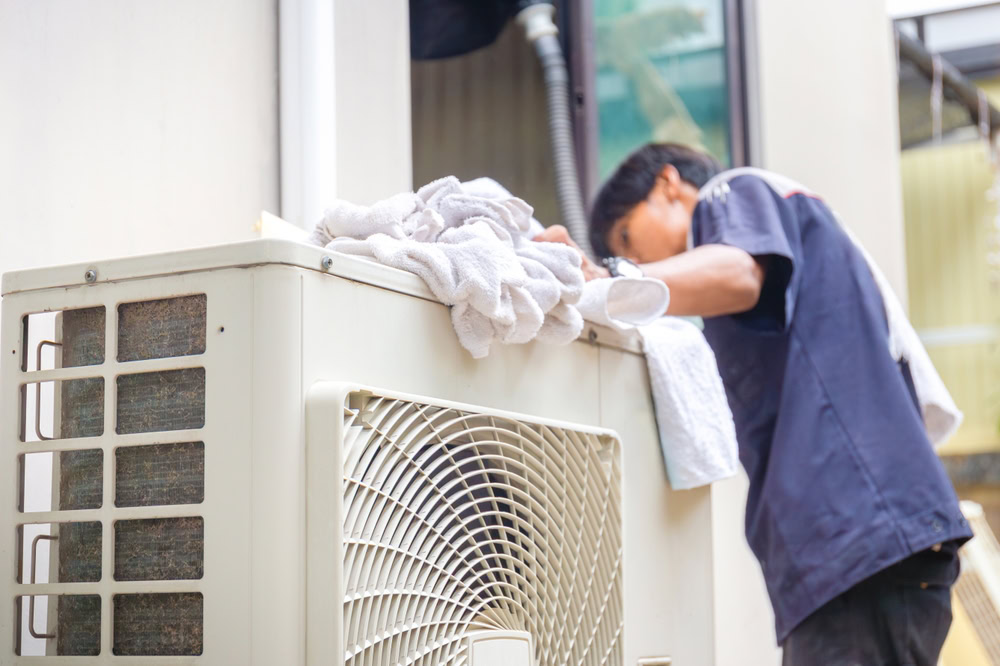
Industry standards put the average lifespan of a central HVAC system at 15 to 20 years. Heat pumps tend to run 10 to 15 years. Gas furnaces land in the 15 to 20 year range. Boilers — which are common in older Queens County homes — can last 20 to 25 years with proper maintenance.
Those numbers are averages, though, and Queens County is not an average market. The urban heat island effect means outdoor condenser units in dense neighborhoods like Jackson Heights or Flushing work harder during summer than they would in a temperate suburban climate. Homes near Jamaica Bay or the Rockaway Peninsula deal with salt air that accelerates corrosion on outdoor components. And Queens County’s older housing stock — much of it built between the 1920s and 1960s — means a lot of systems are already at or past their expected lifespan, even if they’re technically still running.
“Still running” is not the same as running well. A system operating at 60% efficiency is costing you money every single month, even if it never fully breaks down. With Con Edison electricity rates among the highest in the country, an inefficient system hits Queens County homeowners harder than it would almost anywhere else. A unit that was installed when SEER 8 or 9 was standard can be 30 to 50% less efficient than a new system meeting today’s SEER2 requirements — and that gap shows up on your utility bill every summer.
One more thing worth knowing: if your system is still running on R-22 refrigerant — commonly called Freon — it cannot be recharged. R-22 was fully phased out in 2020, and new supply is no longer available. If that’s your situation, replacement isn’t a question of if, it’s a question of when. Waiting until it fails completely usually means paying emergency rates and making rushed decisions.
Cost of HVAC Repair vs Replacement: The $5,000 Rule Explained
The most practical tool for this decision is something the industry calls the $5,000 Rule. Take the age of your system in years and multiply it by the estimated repair cost in dollars. If that number exceeds $5,000, replacement is generally the smarter financial move.
Here’s what that looks like in practice. Say your system is 14 years old and a technician quotes you $420 to replace a failing capacitor and recharge the refrigerant. Fourteen times $420 is $5,880 — over the threshold. That doesn’t mean you’re required to replace it, but it’s a signal that you’re putting money into a system that’s statistically close to the end of its useful life. The repair might hold for another season. Or it might not, and you’ll be back to square one with another bill.
Now factor in the Queens County cost context. HVAC replacement in the NYC metro area typically runs $7,000 to $13,000 for a standard residential system, and higher for larger homes or premium equipment. That’s a real number, and it’s reasonable to hesitate at it. But the Inflation Reduction Act currently provides up to $2,000 in federal tax credits for qualifying high-efficiency replacements, and many utility programs offer additional rebates on top of that. When you spread the net cost over the energy savings a new system delivers — ENERGY STAR-certified units can reduce heating and cooling costs by up to 20% — the payback period is often shorter than people expect, especially given what Queens County homeowners are already paying Con Edison.
One scenario that changes the calculus entirely: a cracked heat exchanger. This is not a repair-or-replace question. A cracked heat exchanger is a carbon monoxide risk, and it means the system needs to come out. Full stop. If a technician identifies this during a service call, take it seriously.
Warning Signs Queens County Homeowners Shouldn't Ignore
Some signs are obvious — the system stops working and you’re sweating through a July night in Bayside. Others are quieter and easier to rationalize away. Both matter.
The clearest signal that replacement is worth considering isn’t a single dramatic failure. It’s a pattern. If you’ve called for service more than twice in the past 12 months, if the repairs are addressing different components each time, if your energy bills have been climbing without a clear explanation — those things together tell a story. Any one of them might be manageable. All of them at once usually means the system is in its final chapter.

What Repeat Repairs and Rising Bills Are Actually Telling You
There’s a version of this situation almost every Queens County homeowner recognizes. You call someone out last August because the AC wasn’t keeping up. They replaced a part, charged you $350, and it held through the end of the season. Then in April you notice the system is running almost constantly and your Con Edison bill is noticeably higher than last spring. Now it’s June and the unit is making a noise it wasn’t making before.
Each of those things, individually, might not be alarming. Together, they’re describing a system that’s compensating for declining performance by working harder — which accelerates wear on everything else, drives up your electricity costs, and increases the probability of a complete failure at the worst possible time.
The financial reality of deferred maintenance is worth understanding: industry data suggests that every dollar of maintenance you skip today tends to become four dollars of repair or replacement cost down the road. Waiting until a system fails completely — rather than replacing it on your own timeline — almost always costs more, because emergency service rates are higher, installation timelines are compressed, and you have less time to evaluate options, compare quotes, or take advantage of financing.
If your system is over 15 years old and you’re seeing any combination of these patterns, the honest answer is that you’re probably past the point where repairs make long-term financial sense. That doesn’t mean you have to replace it today, but it does mean you should get a real assessment from a technician who will give you a straight answer — not just fix the immediate problem and send you a bill.
Emergency Replacement in Queens County: When There's No Time to Wait
Queens County summers are not forgiving. When the urban heat island pushes temperatures into the mid-90s and humidity makes it feel worse, a failed AC system goes from uncomfortable to genuinely dangerous in a matter of hours — especially for older residents and young children. The same is true in winter: a boiler that stops working during a polar vortex event isn’t just an inconvenience.
Emergency replacement scenarios are real, and they happen more often than people expect. The problem is that making a $10,000+ decision under acute stress, in the middle of a heat wave, with a contractor you’ve never used before, is not ideal. The homeowners who navigate these moments best are usually the ones who had already thought through the decision — who knew their system’s age, had a sense of what replacement would cost, and had a contractor they trusted before the emergency happened.
If you’re in that situation right now — system down, no heat or cooling, and you need someone out today — we’re available around the clock, including extended hours during heat waves and cold snaps when demand is highest. We serve Queens County from our Bayside location, and we carry parts for every major system type you’ll find in Queens County homes, from modern central air to the steam boilers still running in pre-war buildings across Astoria and Jackson Heights. We’re not going to tell you that you need a full replacement if a repair will genuinely solve the problem. If the system is worth fixing, we’ll fix it. If it isn’t, we’ll tell you that plainly and walk you through what comes next.
One practical note for Queens County homeowners: HVAC replacement in New York City requires a licensed contractor who can pull the necessary permits through the NYC Department of Buildings. Unpermitted work can create complications with your homeowner’s insurance and cause real headaches when you go to sell the property. It’s worth asking about this when you’re vetting anyone for a replacement job.
Still Not Sure Whether to Repair or Replace? Here's Where to Start
The repair-vs-replace decision doesn’t have to be a gut call made under pressure. If you know your system’s age, have a repair estimate in hand, and understand the pattern of what’s been going wrong, you have most of what you need to think it through clearly.
The short version: systems under 10 years old facing a repair that costs less than half the replacement price are almost always worth fixing. Systems over 15 years old with a history of recent repairs and rising energy costs are usually past the point where continued investment makes sense. Everything in between is where a real conversation with a technician — one who isn’t going to push you toward replacement if repair is the right answer — actually matters.
If you’re working through this decision for a Queens County home and want a straight answer, we’re available to help. Call our Queens County line at 718-428-6987 and we’ll give you an honest assessment of where your system stands.